
Risk bubble
AI investors are confronted with extreme volatility.

AI stocks have dominated the headlines for years. Over the past several months, however, that dominance has become so extreme that virtually every other asset class has suffered as a result. Capital is being pulled away, liquidity is drying up, and fundamentals are increasingly taking a back seat. That last point applies to AI stocks themselves as well. One statistic in particular receives far too little attention.
Semis
For this discussion, I will use the iShares Semiconductor ETF as my benchmark. Semiconductor stocks are, after all, at the very heart of the AI boom. That basket of stocks is up an astonishing 125% over the past year. Quite remarkable. At the same time, it is perfectly understandable why semis receive so much attention. Investors, both retail and professional, as well as market gurus and financial journalists, tend to chase whatever is leading the market.
Risk?
While there is plenty of debate about whether AI has entered bubble territory, and I am not yet convinced myself, very little attention is paid to the other side of the return equation: volatility.
And it is every bit as remarkable.
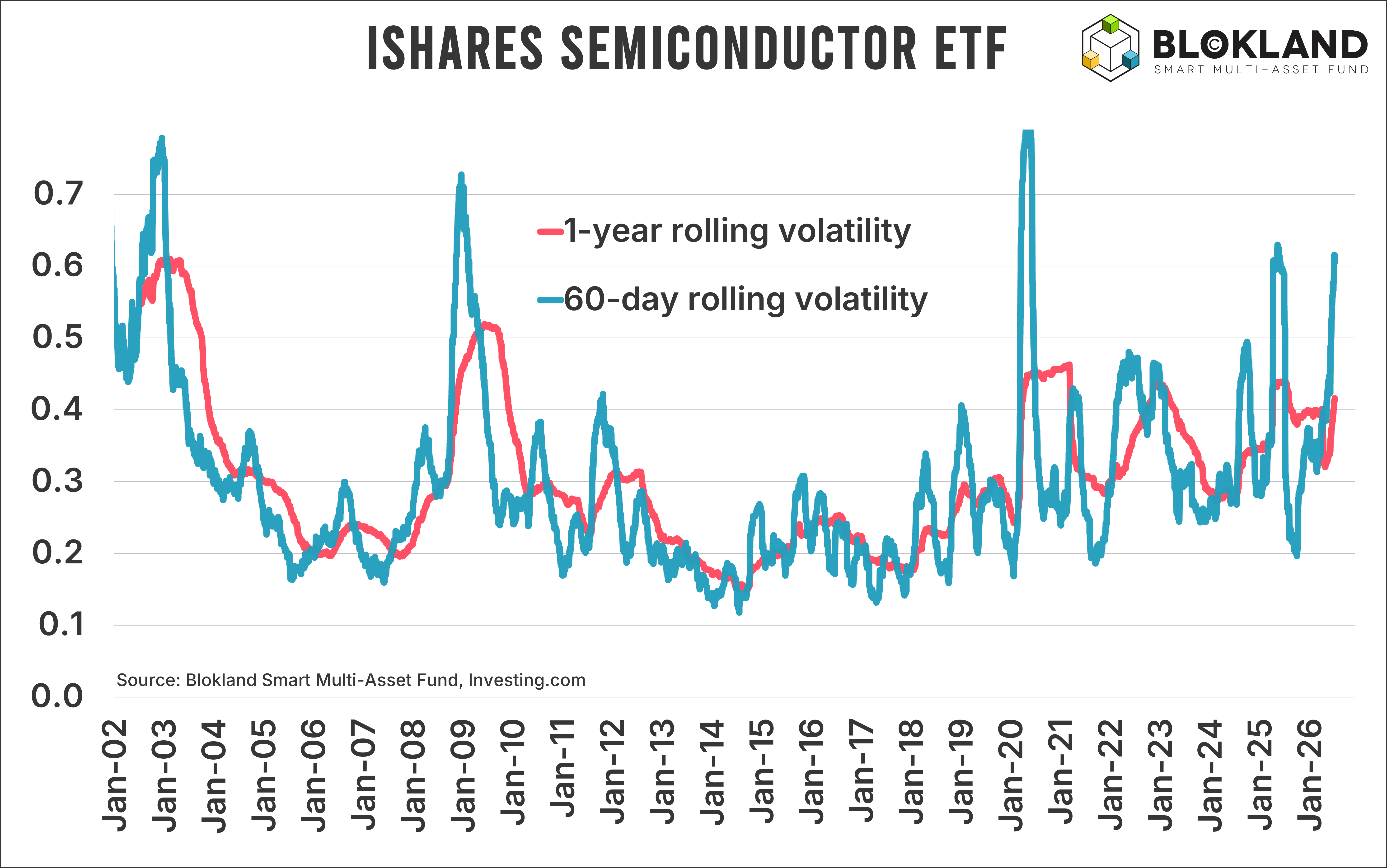
Over the past year, semiconductor stocks have exhibited annualized volatility of 41%. Over the past sixty trading days, realized volatility has reached a breathtaking 63%.
Surely you only see that kind of volatility in bitcoin?
Not really. Over the past sixty trading days, bitcoin’s volatility has been less than half that of semiconductor stocks.
Risk levels like those of semiconductor stocks are normally seen only during major financial crises, as the chart below illustrates. The difference today, of course, is that there is no crisis. At least not yet.
In the dark
That the AI boom is producing extraordinary market behavior is once again evident from recent price action. Over the past ten trading days, the iShares Semiconductor ETF has recorded an average daily price move of 5%.
That is just wild.
If you decide to invest today, you literally have no idea what to expect. With a bit of bad luck, your investment could be down 10% almost instantly. Swings of that magnitude make any investment, no matter how strong the underlying fundamentals may be, inherently less attractive.
You are investing completely in the dark, with no idea what tomorrow may bring.
Cracks
The price history of the iShares Semiconductor ETF begins in 2001, just after the dot-com bubble had fully burst. But when I look at the S&P 500 Information Technology Index, which goes back much further, I notice something interesting.
In both 1997 and 1998, there were two periods in which volatility surged to extreme levels while the rally continued unabated. In fact, prices rose almost exponentially for another seventeen months.
Half Full
Market rallies almost always last longer than most investors expect, especially when a new technology emerges whose ultimate impact is impossible to estimate during the first few years, and sometimes even decades. That is why I am not expecting a new financial crisis just yet.
Nor because the rally is, to a large extent, supported by strong earnings growth. However, there are, at times, valid reasons to question some of those numbers. NVIDIA invests $100 billion in OpenAI, which then spends that same $100 billion on NVIDIA systems, after which NVIDIA reports the resulting revenue as profit.
So let’s call the glass half full.
In my view, however, that extraordinarily high volatility deserves far more attention. Perhaps it will encourage investors to take another serious look at the fundamentals of other asset classes.
The Emergency Brake
The Blokland Smart Multi-Asset Fund uses the Emergency Brake, an objective risk indicator designed to limit losses when financial market sentiment deteriorates significantly. Once the Emergency Brake is activated, the fund temporarily reduces its equity exposure. Only after market sentiment has recovered sufficiently is that position rebuilt.
Historical simulations show that the Emergency Brake adds the most value during prolonged bear markets, such as the dot-com bubble and the Global Financial Crisis of 2008. It also significantly reduced losses during the COVID crisis, when global equity markets fell by more than 30% in a very short period of time.
By reducing equity exposure during periods of elevated risk, the Emergency Brake lowers the overall risk of the portfolio. It also helps investors avoid one of the most common pitfalls in investing: making decisions driven by emotion. Especially during periods of sharp market declines, an objective and disciplined approach helps maintain a long-term perspective.
If you would like to learn more about the Emergency Brake or the Blokland Smart Multi-Asset Fund, please contact us at info@bloklandfund.com or use the contact form on our website.

The circular NVIDIA-OpenAI revenue point is the one that should worry people more than the volatility number, Jeroen.
Across 69 providers, the CMA consensus on US Equities carries the widest dispersion of any developed market, SD of 1.74, and the expected return itself just moved up this quarter, to 6.21%.
That's allocators raising the bar on future returns while quietly admitting they don't agree on what today's earnings are actually worth.